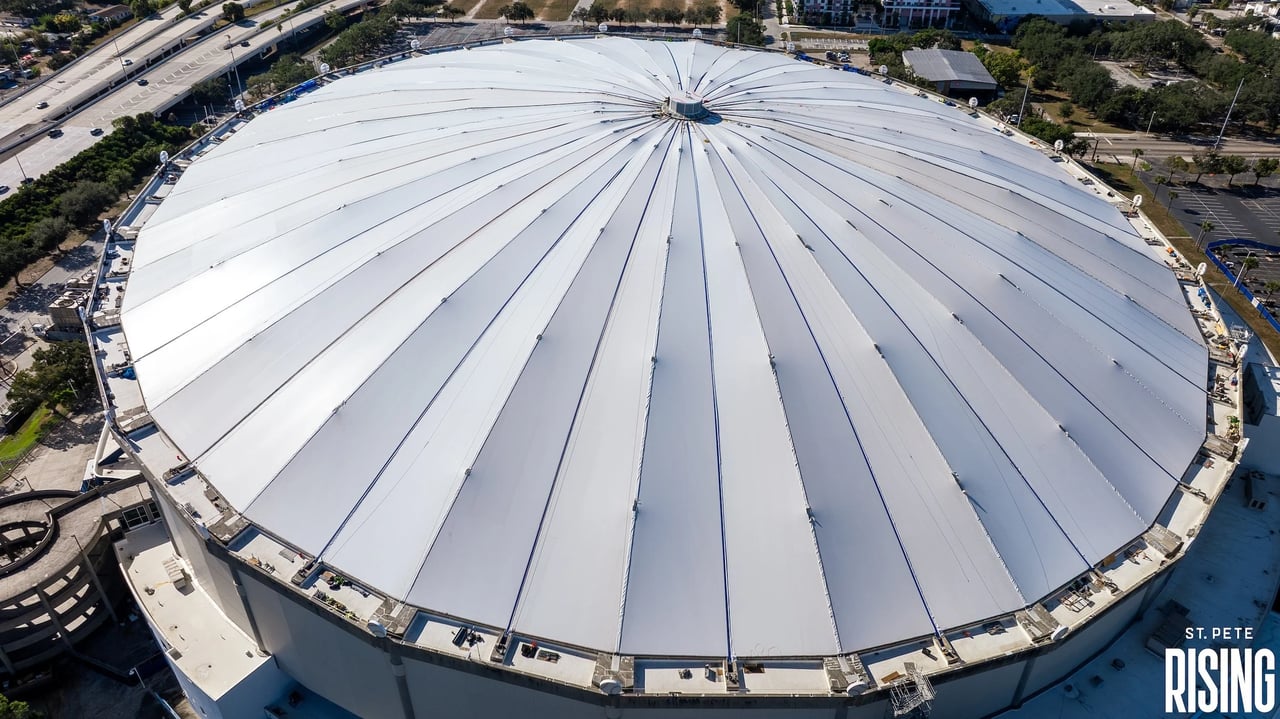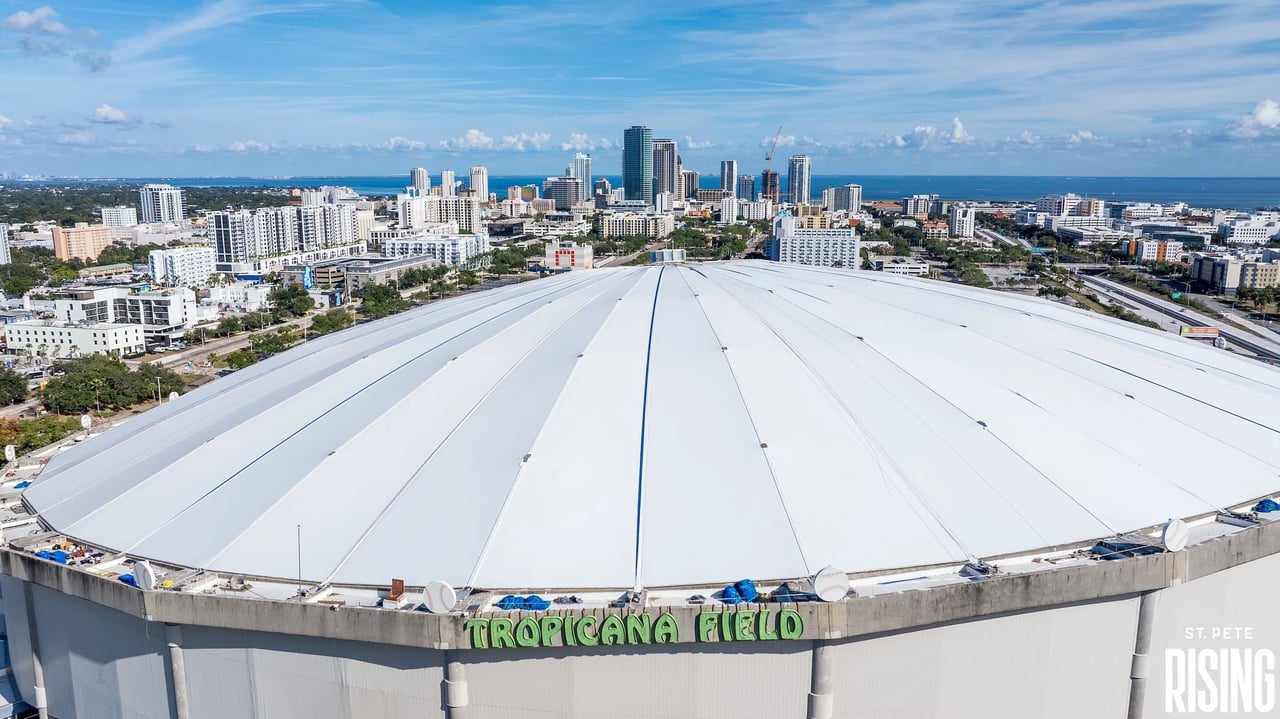
A newly completed white dome now tops Tropicana Field as the City of St. Petersburg advances a more than $60 million renovation project, reinforcing long term confidence in downtown infrastructure and surrounding real estate development.
For investors, property owners, and developers tracking St. Petersburg’s growth trajectory, the Tropicana Field renovation represents more than a stadium repair. It reflects the city’s commitment to maintaining major civic assets while broader redevelopment conversations continue across the Tampa Bay region.
A Major Capital Investment in Urban Infrastructure
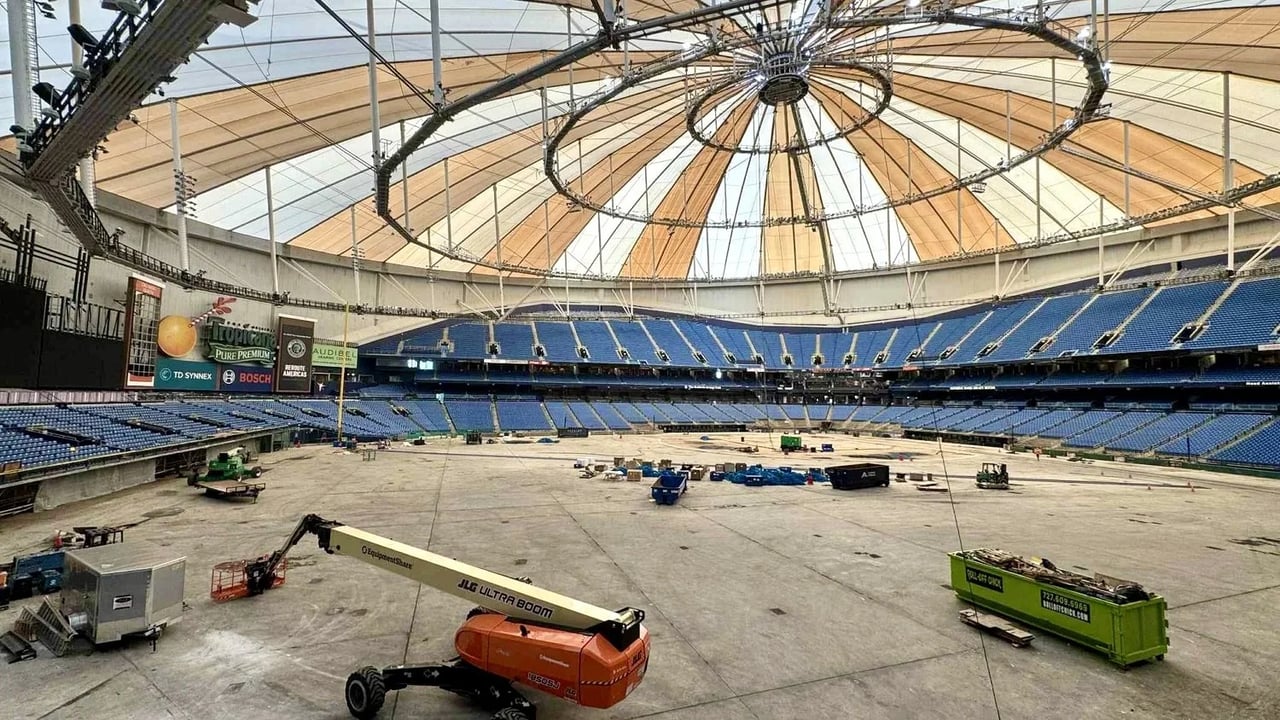
Inside Tropicana Field, more than 200 workers are currently installing and sealing the new roof while interior systems come back online. According to city officials, the building is now fully dried in and remains on schedule to reopen for Opening Day on April 6, 2026.
The $22.5 million roof replacement, constructed from advanced PTFE fiberglass membrane, is designed to withstand winds up to 165 miles per hour. This investment follows significant damage caused by Hurricane Milton and forms the backbone of a broader restoration effort exceeding $60 million.
From a development standpoint, infrastructure resilience has become a key factor in coastal real estate markets. St. Petersburg’s decision to invest heavily in storm hardened public assets sends a strong signal to institutional investors and developers evaluating long term risk.
Downtown St. Pete Stability While Long Term Plans Evolve
Although the Tampa Bay Rays are under contract to play at Tropicana Field through 2028, the city is required to maintain the facility regardless of future stadium decisions. During the 2025 season, the Rays played home games in Tampa, but city leadership emphasized there is no concern about readiness for the 2026 return.
For nearby neighborhoods, including Downtown St. Petersburg, Edge District, Grand Central, and the Warehouse Arts District, the renovation helps preserve consistent foot traffic, event activity, and economic spillover that support surrounding residential and mixed use properties.
Construction Progress and Economic Impact
St. Petersburg partnered with Hennessy Construction Services and AECOM Hunt, beginning roof installation in August and completing the final panel in November. With interior construction accelerating, the on site workforce is expected to double to approximately 400 workers.
Interior improvements include new drywall in media areas, electrical system replacements, repainted seating, repaired lighting structures, upgraded concourses, and new field turf scheduled for installation in January. Air conditioning in the seating bowl has already been restored.
Before reopening, Greenfield Environmental Inc., a St. Petersburg based consulting firm, will conduct indoor air quality testing to address mold and mildew concerns that developed during prolonged exposure.
MLB Standards and Public Private Investment Balance
City officials confirmed ongoing coordination with Major League Baseball, which continues to refine stadium standards. Certain storm related repairs now require upgrades rather than direct replacements.
One example is expanded protective netting behind home plate, which will now extend to the foul poles. That upgrade will be funded through the city’s Capital Repair, Renewal and Replacement Sinking Fund, supported by naming rights revenue and ticket fees rather than general tax dollars.
The Rays are also contributing independently through suite upgrades, new digital ribbon boards, enhanced graphics, and the return of the popular live stingray touch tank in partnership with The Florida Aquarium.
What This Means for St. Petersburg Real Estate
For real estate investors and buyers, the Tropicana Field renovation underscores several important themes:
• Continued public investment in downtown infrastructure
• Emphasis on climate resilience in coastal construction
• Ongoing economic activity tied to large scale venues
• Stability for nearby residential, retail, and mixed use developments
While the Rays’ long term stadium location remains under evaluation following the team’s $1.7 billion sale, the city’s willingness to invest today helps stabilize the surrounding market and preserve development momentum.
Looking Ahead
All renovations are scheduled for completion by March 2026, positioning Tropicana Field to reopen on schedule. As conversations about future stadium sites and redevelopment continue, this project demonstrates St. Petersburg’s proactive approach to infrastructure, resilience, and long term urban planning.
For buyers, developers, and investors evaluating Downtown St. Petersburg real estate, the message is clear. The city continues to invest, adapt, and position itself for sustained growth.
Aaron Hoffman / Cømpass Real Estate St.Petersburg.FL / 813.817.7914